
Gemstone Certification Guide: How to Read a Laboratory Report

Updated: 2 days ago
This gemstone certification guide explains what a laboratory report can tell you, what it cannot and how to verify that it corresponds with the gemstone being offered. It also covers treatment and origin wording, local laboratories and the warning signs that deserve closer investigation.
A report is an important piece of evidence, but it should never be treated as a guarantee of quality, value or a sound purchase.
What Is a Gemstone Certificate?
The term “gemstone certificate” is widely used by buyers and sellers, but “laboratory report” is more accurate. A reputable report describes observations and test results for the gemstone examined. It does not certify quality, establish a price, guarantee future value or make the buying decision for you.
Depending on the laboratory and the stone, a report may include identity, weight, measurements, treatment information and sometimes an opinion on geographic origin. Always read the exact wording and verify the report number directly with the issuing laboratory.
What a Gemstone Certificate Shows
A clear, trustworthy certificate should include:
• Lab Name & Contact Info: Full name, address, and website of the issuing lab.
• Unique Report Number: Verifiable on the lab’s official portal.
• Species & Variety: Exact gem identification (e.g., corundum — sapphire).
• Carat Weight & Measurements: Length, width, depth, and total carat.
• Colour Description: Hue, tone, and saturation using industry-standard terms.
• Clarity Grade: Visible inclusions and overall transparency.
• Treatment Disclosure: Heat, diffusion, or filling processes clearly stated.
• Origin (Optional): Lab opinion on geographic origin, when available.
Tip: Some small labs provide useful local insights, especially near mines, but they may not carry the same global authority as labs like GIA or SSEF.
By the end of this gem certification guide, you won’t just understand certificates, you’ll know how to use them to your advantage. And if you pair this knowledge with my Gem Buying Checklist and Buyer Protection strategies, you’ll approach every gemstone purchase with clarity and confidence.
Understand, this isn’t about alarmism...it’s about buying with clarity and confidence.
Recognised Independent Gemmological Laboratories
For a high-value coloured gemstone, the choice of laboratory matters. Established independent laboratories commonly used for coloured stones include:
GIA: Gemological Institute of America
SSEF: Swiss Gemmological Institute
Gübelin Gem Lab
AGL: American Gemological Laboratories
The appropriate laboratory can depend on the gemstone and the type of report required. Check that the laboratory offers the relevant service before submitting a stone. Its role is to examine and describe the gemstone, not to set its retail price or decide whether it represents good value.
Small Laboratories and Local Testing
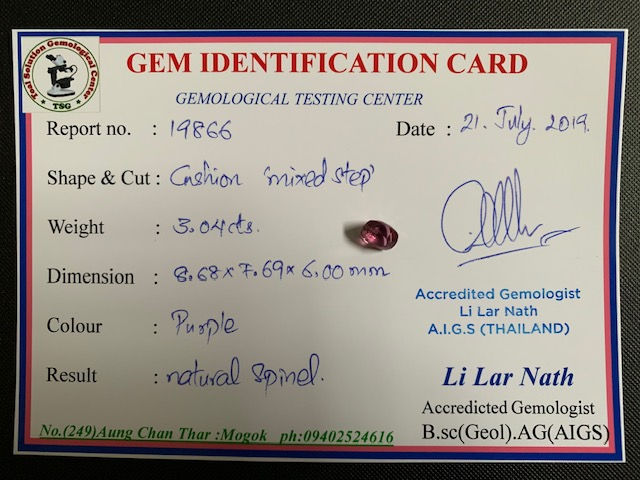
Smaller local laboratories can provide useful initial testing, particularly in gemstone-producing regions where access to major international laboratories is limited.
During a visit to Mogok, Myanmar, I took a spinel to a local laboratory operated by gemmologist Li Lar Nath. The findings helped inform my decision at the time. For a higher-value purchase, however, a local report may still need confirmation from an internationally recognised laboratory.
Do not judge a laboratory by location or presentation alone. Check its independence, the gemmologist’s qualifications, the testing available and whether the report can be verified directly.

How to Read a Laboratory Report
Read the laboratory’s exact wording rather than relying on the seller’s interpretation. Pay particular attention to:
Identity: Does the report clearly identify the gemstone and state whether it is natural or laboratory-grown?
Treatments: What has the laboratory detected, and what does its precise wording mean?
Origin: Is a geographic origin stated, and is it presented as an opinion?
Measurements and weight: Do these correspond with the gemstone being offered?
Comments and limitations: Has the laboratory included any qualifications or additional observations?
If important information is missing, do not assume what the answer might be. Check whether that information was included within the report service and ask the issuing laboratory for clarification where necessary.
Warning Signs on a Gemstone Report
A professional-looking document is not proof that a gemstone has been independently tested. Check carefully for:
a report number that cannot be verified on the laboratory’s official website
contact details or a website that do not match the laboratory’s official information
measurements, weight or descriptions that do not match the gemstone
vague or unclear treatment wording
an unfamiliar organisation with no verifiable address, qualifications or testing information
a seller’s certificate of authenticity being presented as an independent laboratory report
I once bought what was represented as a natural Burmese ruby in Egypt, accompanied by a “certificate”. Later testing showed that it was treated glass rather than the natural ruby claimed. The document looked convincing, but it did not provide reliable independent evidence.
How to Verify a Gemstone Report
Visit the laboratory’s official website independently and find its report-verification service.
Enter the report number and confirm that a matching record exists.
Compare the identity, weight, measurements, treatment findings and any photograph with the actual gemstone.
Check that the report type covers the information being claimed by the seller.
Contact the laboratory directly if anything is missing, inconsistent or unclear.
Holograms, QR codes and professional presentation may support a report’s authenticity, but they should not replace direct verification with the issuing laboratory.
Download my free Gemstone Report Verification Checklist and keep it to hand when reviewing laboratory reports or seller paperwork. It summarises what to verify and helps you check whether the document corresponds with the gemstone being offered.

Watch my video on buying jewellery abroad safely.
Why the Report Must Match the Gemstone
Finding a valid report number is only the first step. It confirms that the laboratory issued a report, but you must still establish that the document belongs to the gemstone being offered.
Compare the weight, measurements, shape, colour description and photograph, where provided. Any significant inconsistency should be investigated before purchasing.
For a high-value gemstone, consider an independent in-person examination or fresh laboratory testing if you cannot confidently connect the report to the stone.
Why Laboratory Reports Matter for Collectors
A reputable laboratory report can:
provide independent evidence about identity and detected treatments
help you compare the documented characteristics of different gemstones
support insurance, cataloguing and future ownership records
provide an opinion on geographic origin when that service is included
create a clearer record of what was represented at the time of purchase
A report is evidence, not a buying recommendation or valuation. It should be considered alongside the actual gemstone, the seller’s disclosures and the asking price. My Gemstone Buying Checklist and in-person Buyer Protection service can help you assess the wider purchase.
Final Report Checklist Before You Buy
Before committing to a purchase:
verify the report number through the laboratory’s official website
confirm that the gemstone’s weight, measurements and description match the report
read the treatment and origin wording carefully
check that the report type covers every claim being made by the seller
ask for clarification where information is missing or inconsistent
consider independent in-person examination or fresh laboratory testing for a high-value purchase
FAQ: Gemstone Laboratory Reports
What is a gemstone certificate?
“Gemstone certificate” is the commonly used term for a laboratory report describing the results of testing a particular gemstone.
Does a laboratory report guarantee quality or value?
No. It does not set a price, guarantee quality or confirm that a gemstone represents good value.
How do I verify a gemstone report?
Check the report number on the issuing laboratory’s official website and compare the recorded details with the actual gemstone.
Can reports from smaller local laboratories be useful?
Yes, but their reliability depends on their independence, expertise, testing capabilities and report verification. A high-value gemstone may require confirmation from an internationally recognised laboratory.
Does every report include geographic origin?
No. Origin determination is a separate service offered by some laboratories and is generally expressed as an expert opinion.
Kim Rix GG GIA
Independent Gemstone Sourcing Specialist
Gemstone Detective


